Segunda textualidad

El martes pasado escuché dos charlas breves sobre el libro digital. Fue en un evento dibujado en vivo.
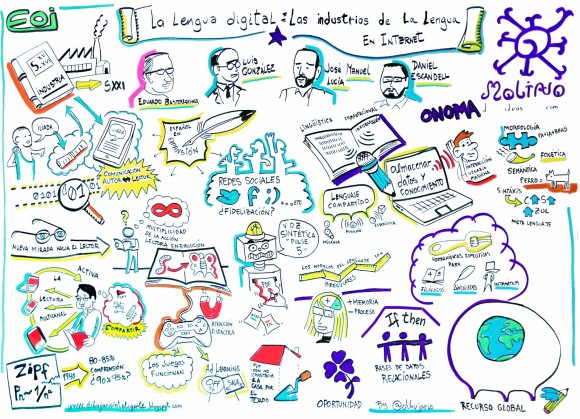
Informe gráfico del evento de Fernando de Pablo «Dibujario»

Los que hablaron de libros fueron las dos personas del centro.

Autor

Primero, José Manuel Lucía desde la perspectiva del autor. Me gustó que insistiera en que lo importante del libro era el texto, no el objeto. La interacción entre autor y lector en la fase pre- y post-artefacto, la llamó «segunda textualidad». Una especie de vuelta a la oralidad, a la diversidad de versiones. Un mejor aprovechamiento de la lengua.

Curiosidades

No sabía que Leonardo da Vinci despreciaba el libro porque pensaba que haría que las personas fueran más imbéciles. Ahora ocurre lo mismo con la Red, algunos la culpan de un supuesto atontamiento de las nuevas generaciones.

Habrán oído, a estas alturas, también la queja de que «ahora cualquiera piensa que puede escribir». ¡Vamos, el mismo argumento interesado que empleaban los detractores de la imprenta industrial cuando ésta desplazaba a la artesanal.

Lector

Si lo importante del libro es el texto, el centro de gravedad de la lectura es el sujeto, el lector. Luis González, de la Fundación GSR, dio una definición del lector que incluye funciones de las que tanto se habla últimamente, pero como cosas separadas: el filtrar, curar y crear contenidos. Una celebración, precisamente, de que «cualquiera puede escribir».

Lector: persona que realiza un ejercicio de curiosidad, interpretación, comprensión, valoración, creación, asimilación y compartición.

«Cuando acabe la guerra de las plataformas»

Respecto a la industria del libro, todos los que hablaban transmitían que tenía que reinventarse según las nuevas reglas del juego y entender el negocio editorial como servicio en lugar de suministro. Mientras Amazon está camino de abarcar la mayor parte del mercado del libro electrónico, en este evento se hablaba del final del DRM y del mundo después de la «guerra de las plataformas cerradas».

Academic vs learning analytics and the point of trust

Second week in LAK12 was slightly less intense for me than the first. It might be because I didn’t attend neither of the live sessions which are, I think, emotionally the most significant activities of the course.

I was happy to receive clarifications about the difference between academic and learning analytics in comments. It helped me to further think about this domains. I kind of came to the conclusion that in a knowledge economy, with the individual having the main responsibility for developing skills and competences, while there perfectly might be learning analytics without academic analytics, the other way round would be problematic and serve only the survival of institutions.

I found it interesting to encounter the Penetrating the fog article among the course content, as I already read it some months ago. I bookmarked it then highlighting the sentence

Learning analytics can penetrate the fog of uncertainty around how to allocate resources, develop competitive advantages, and most important, improve the quality and value of the learning experience.

This time, I bookmarked it highlighting

Since we risk a return to behaviorism as a learning theory if we confine analytics to behavioral data, how can we account for more than behavioral data?

I also fully share Dr. Sharon Slades’ concern when she says

In trying to adapt and change our teaching and support models for the better, are we in danger of simply replacing one inappropriate design for another?

The other two course materials I have read this week were Bakers’ Data mining for education, and the SOLAR groups’ Open Learning Analytics: an integrated & modularized platform. The two showed useful applications of academic and learning analytics. The latter definitely clarifies the difference between the domains.

The SOLAR document outlines a very interesting approach to learning analytics based on interoperability, opennes and collaboration, in line with the free software movements’ philosophy. One thing I still miss —in this document and all the others— is the question about the ownership of the data. Again, because of the individual bearing the main responsability for the learning process, each person should have an owner attitude regarding their data and, whenever possible, the physical ownership of it. This would incentivate institutions to build the trust necessary to have individuals share their data. This kind of —disintermediated— trust is very different from the one that involves working with data from centralized web platforms, like Facebook, G+, Twitter or LMSs.

Tumblr cubre la tumblerosfera

Estoy pensando en la diferencia entre un periódico gratuito invitando a bloggers a bloguear bajo su bandera por la cara, y Tumblr creando un periódico para cubrir la tumblerosfera de 42 millones de blogs. Se me presenta inevitable que acaben siendo lo mismo: una estructura de información centralizada, con linea editorial con la que es imposible, ni nada deseable, que se identifiquen 42 millones. Al final, antes de abrirnos un blog en Tumblr, nos preguntaremos si queremos que Tumblr nos cubra. Y esto será bueno, por quedar explícito su modelo —centralizador— y lo que éste significa.

Estatus y consultoría

Interesante reflexión de Robin Hanson sobre por qué las empresas están dispuestas a pagar ingentes cantidades de dinero a grandes firmas de consultoría pese a que los consultores que éstas les envían son recién salidos de la uni, con mucha menos experiencia que cualquiera de las que va a asesorar.

My guess is that most intellectuals underestimate just how dysfunctional most firms are. Firms often have big obvious misallocations of resources, where lots of folks in the firm know about the problems and workable solutions. The main issue is that many highest status folks in the firm resist such changes, as they correctly see that their status will be lowered if they embrace such solutions.

The CEO often understands what needs to be done, but does not have the resources to fight this blocking coalition. But if a prestigious outside consulting firm weighs in, that can turn the status tide. Coalitions can often successfully block a CEO initiative, and yet not resist the further support of a prestigious outside consultant.

To serve this function, management consulting firms need to have the strongest prestige money can buy. They also need to be able to quickly walk around a firm, hear the different arguments, and judge where the weight of reason lies. And they need to be relatively immune to accusations of bias – that their advice follows from interests, affiliations, or commitments.

All three of these functions seem to be achieved at a low cost by hiring good-looking kids from our most prestigious schools. These are the cheapest folks you can buy with our most prestigious affiliations, they are smart enough to judge where reason lies, and they have few prior affiliations to taint them with bias. They can not only “borrow your watch to tell you the time,” but can also cow you into submission in accepting that time.
Robin Hanson

Rastros significativos de aprendizaje

Me cuesta captar las diferencias entre analítica del aprendizaje, analítica académica y minado de datos en la educación. Intuyo que tienen su origen en las diferencias entre distintos grupos de académicos que se ocupan del asunto y que, para diferenciarse unos de otros, usan nombres distintos para hablar del asunto bajo su propia mirada. Algo que, me parece, tiene todo el sentido.

De los tres términos, el que tiene la palabra «aprendizaje» en su nombre, es la que da sentido al término desde la mirada de la persona que aprende, tratándole como propietario de su propio aprendizaje. Bajo esta mirada, lo que se quiere es empoderar al aprendiz para aprender mejor. Ese es también mi interés en el tema.

En el terreno de los métodos, los tres enfoques se encuentran. En todos, la cuestión es captar rastros significativos de aprendizaje.

Of course, capturing meaningful learning traces is something that both we and the EDM community struggle with. Translating those traces into visual representations and feedback that support learning is another challenge: the danger of presenting meaningless eye candy or networks that confuse rather than help is all too real.
Erik Duval

La mención del meaningless eye candy en referencia a herramientas vistosas como esas que generan grafos sociales, apunta a la dificultad de aplicar algoritmos a fenómenos como el aprendizaje, en los que la confianza entre las personas y la identidad, tienen un papel fundamental.